
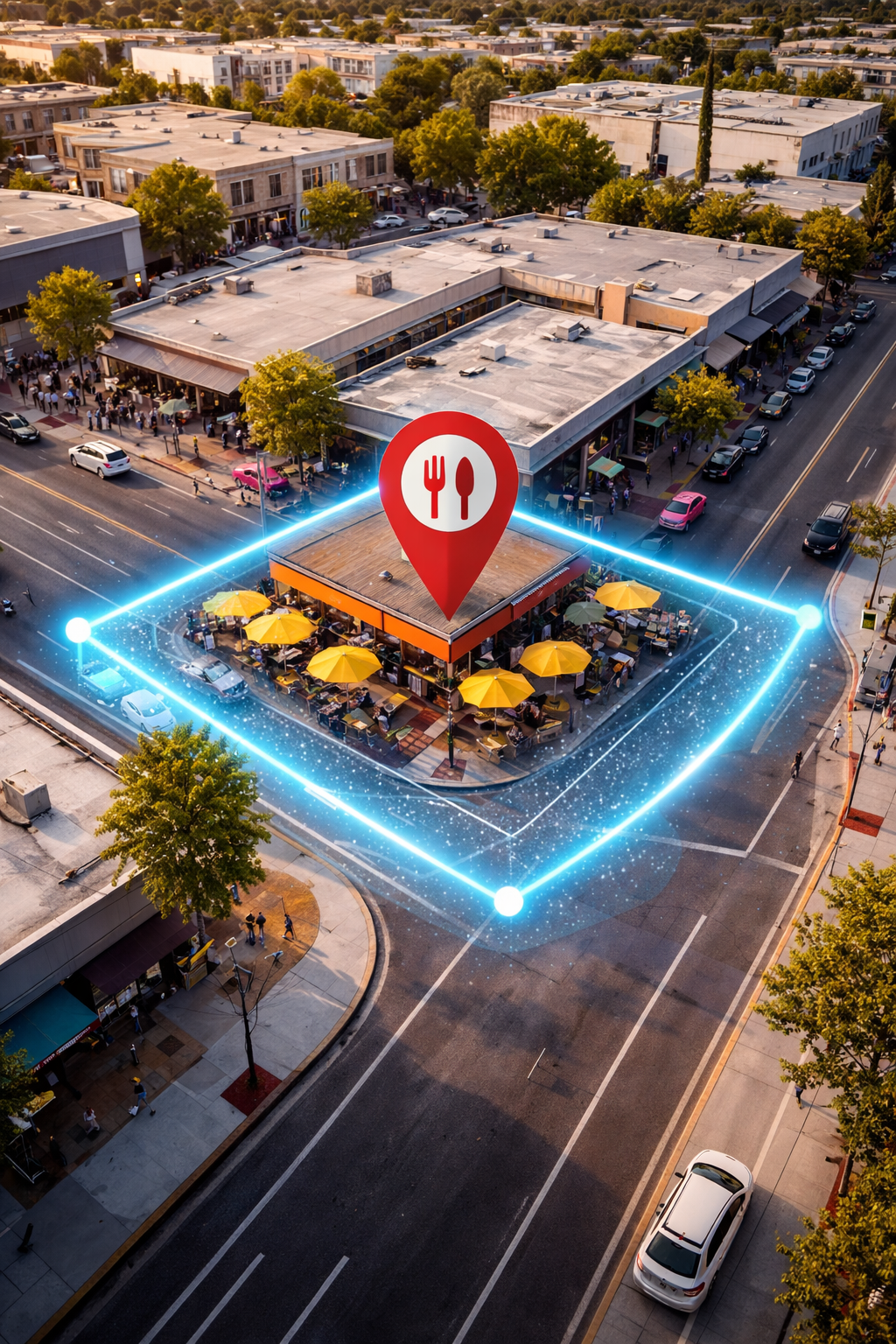
You might be wondering “What is geofencing advertising?” if you’ve heard the term, but no one has clearly explained it to you. To put it into basics, it is primarily a tactic used in a hyper targeted, location based advertising model. It has been around for a while, but it’s not casually discussed because there is a process behind it, and requires in depth explanation to those who don’t understand what it is.
Imagine drawing an invisible fence around your competitor’s location. Every time someone walks into that fence with their mobile phone, they see your ad.
Those ads don’t interrupt their phone. Instead, they appear naturally in mobile apps, websites, streaming platforms, and other digital placements they already use.
As long as location services are enabled on their device, your ad can be delivered during or after that visit.
That’s what geofencing advertising is.
Geofencing Is Only One Tactic, and Just The Starting Point
Most people hear the term “geofencing” and think it’s location based advertising only. However, the most effective campaigns go further with more variables involved. We layer in additional targeting signals alongside location. There are other tactics that are included in hyper targeted advertising such as: behavioral patterns, keyword search activity, demographic data, and even channel specific placements on streaming services.
Think of geofencing as the foundation. Everything else we build on top of it is what turns a good campaign into a great one. When someone walks into your competitor’s fence, and matches your ideal customer profile, that’s not just an impression, it’s a precision strike that will help us to optimize your campaign for it to be at its optimal performance.
More About The “Geo Fence” Tactic:
Targeted customers don’t even necessarily need to be on their phone at that time. They can be pinpointed long after they go home, or elsewhere. Your ad will be readily available for them when they do get on their phone.
A virtual boundary line is placed around any location the advertiser chooses. For instance, a competitor’s parking lot, a trade show, a neighborhood, a shopping center, or even a specific address. The ad is then served directly to the people inside that narrowed boundary.
When they leave and browse their phone later that day, your ad follows them, and when they walk through your door, we are able to measure and identify that person as someone who saw your ad.
Not only can you target your customers by their precise location, but as I previously mentioned, you can also utilize this targeted marketing through other demographics. These other demographics include things such as: gender, interests, and even putting a commercial (or video ad) on a specific channel they’re watching on Netflix, Hulu, or another streaming service. They can also be targeted by visitation patterns (e.g. people who frequent gyms, restaurants, health stores, etc.)
In addition, ads can appear across multiple channels, including: select digital outdoor placements (DOOH), mobile and desktop websites, search based display inventory, and mobile apps.
All targeted marketing is done anonymously and compliantly.
What Is Geofencing Advertising & How Results Are Measured
Unlike traditional advertising, geofencing advertising provides clear performance reporting, including:
- number of impressions delivered
- clicks and engagement
- visitation lift (when available)
- cost efficiency metrics
This allows businesses to understand what they’re paying for and what kind of response their ads are generating.
Therefore, unlike traditional advertising, this type of hyper targeted, mobile geofencing advertising is not only measurable, but it’s also one of the most effective advertising models there is.
Example of Return On Marketing Investment With Hyper Targeted Advertising:
Let’s say you’re a restaurant, and your average customer is worth only $40. You start a marketing campaign for 100,000 views of your ad. From that ad you get 500 new customers. That is $20,000 in extra revenue for your business.
( These numbers are not a guarantee, results vary by industry, offer, and execution. However, it reflects average conversion and performance ranges. It also illustrates why many businesses are willing to invest in geofencing when it is structured and measured correctly.)
What It Is & Who Geofencing Advertising Is For?
Geofencing advertising works for virtually any business. However, brick and mortar businesses such as restaurants, gyms, salons, auto dealers, retail stores, medical offices, law firms, and others generally benefit the most. This is because foot traffic can be measured when you have a physical location. If your customers have a mobile phone, and your competitors have a location, geofencing can work for you.
Even a plumber, locksmith, HVAC, and other types of service businesses can also benefit from this type of effective advertising. While you wouldn’t be able to pinpoint a competitor’s location (Unless they have one with foot traffic), or measure foot traffic if you don’t have a physical location, you can still pinpoint a radius, or neighborhood that you want to target. You could even pinpoint places like Home Depot or Lowes where your customers might be hanging out. You can also target other demographics aside from location with other hyper targeted advertising options.
The Process:
- Business & Visibility Audit: We start with a detailed audit of your online presence, traffic, competitive landscape, and your overall business insights.
- Audience & Competitor Analysis: Then we will go over your competitors, your ideal customers, and their demographics.
- Campaign Planning & Launch: We determine realistic customer goals, your budget, finalize pricing, and launch your campaign.
- Performance Reporting & Optimization: After the first month, we will run the reports to see how many views your ad received, and how many conversions it gave you. Geofencing advertising works a lot like search ads, and typically takes about 3 months of refining, and optimizing to make sure you’re getting the most out of your advertising dollars.
- Ongoing Side By Side Competitor Analysis Report: Not only do we give you the conversion reports, but we give you the option to receive an ongoing side by side monthly analysis report between you and your competitor(s) and what areas you are improving and / or declining.
- Automation & Retargeting: After your campaign runs for at least 1-3 months, and you start getting customers, we will then help you to implement remarketing automation tools. With these tools, you can ensure that you don’t lose customers once the geofence brings them in. You will essentially be able to retarget customers, send them promotions, and keep them returning to you.
Let’s have a chat, and see how we can help you with your business. Productive Business Solutions FAQ: Strategic Growth for Small Businesses
Hyper Targeted Advertising FAQ
Here are some common questions about how our hyper targeted advertising campaigns work.